Technique
The hip hinge: the pattern everyone thinks they can do
Deadlifts, Romanian deadlifts, good mornings, kettlebell swings and every athletic movement that produces force from the ground share one pattern, and most people squat it instead.
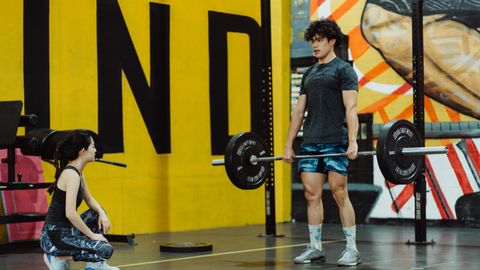
The hip hinge is bending forward by moving the hips backward, with minimal knee bend and a spine that does not change shape. It is the foundation of the deadlift family and one of the two fundamental lower body patterns.
It is also the one most people cannot do properly on their first attempt, because the natural response to "bend forward" is to either squat or to round the back.
What it should look like
The hips travel backwards. The torso comes forward as a consequence of the hips moving, not as an independent action. The knees bend slightly and then stay put. The shins remain close to vertical. The spine holds its natural curve throughout.
The sensation is a stretch through the hamstrings, increasing as you descend, and a sense that you would fall backwards if you went further.
The distinction from a squat
In a squat, the knees travel forward substantially, the hips drop more than they travel back, and the torso stays relatively upright.
In a hinge, the knees barely move, the hips travel back a long way, and the torso comes down toward horizontal.
Most lower body movements are somewhere on a spectrum between these — a conventional deadlift is more hinge than squat, a front squat is nearly pure squat, a low-bar back squat sits in between. Knowing where a movement should sit is what stops you from performing the wrong one.
Teaching yourself the pattern
The wall drill. Stand a foot or so from a wall, facing away. Push the hips back until they touch the wall, keeping the shins vertical and the spine neutral. Step further away and repeat. This teaches the backward hip travel without any load.
The dowel drill. Hold a stick along your spine, contacting the back of the head, the upper back and the tailbone. Hinge while maintaining all three contact points. Losing contact at the head means the neck is dropping; losing it in the middle means the back is rounding; losing it at the tailbone means the pelvis is tucking.
Do these until the pattern is automatic. Loading a hinge you cannot perform is how backs get irritated.
The Romanian deadlift
The purest loaded hinge, and probably the best hamstring and glute developer available.
Start standing with the bar. Push the hips back, keeping the bar close to the legs — it should almost drag down the thighs. Descend until you feel a strong hamstring stretch and cannot go further without the back rounding, which for most people is somewhere between mid-shin and just below the knee. Then drive the hips forward to stand.
Key points: the bar stays in contact with or very close to the legs the whole way. The range is determined by hamstring flexibility, not by touching the floor. The back position does not change. Control the descent — this is an eccentric-dominant exercise and rushing the lowering wastes most of the value.
Do not go to the floor unless you can maintain a neutral spine there. Most people cannot.
Common faults
Turning it into a squat. Knees drifting forward, hips dropping rather than travelling back. Usually means the load is too heavy or the pattern is not established.
Rounding the lower back at the bottom. Means you have exceeded your available range. Stop higher.
The bar drifting away from the body. Increases the load on the lower back substantially. Engage the lats and think about pulling the bar into the thighs.
Hyperextending at the top. Standing up and leaning back adds nothing and loads the lumbar spine. Finish standing tall with the glutes squeezed.
Looking up. Craning the neck to watch yourself in a mirror breaks the spinal position. Keep the neck in line with the spine and let the gaze travel with the torso.
The variations and what they add
Good mornings. Bar on the back, same pattern. Loads the erectors and hamstrings heavily with less absolute weight, which makes it a useful accessory. Start very light; the leverage is brutal.
Kettlebell swings. A ballistic hinge. Excellent for teaching explosive hip extension and for conditioning. The swing is a hinge, not a squat, and not a front raise — the arms are ropes and the bell floats up as a consequence of the hip snap.
Single-leg Romanian deadlifts. Add a balance and hip stability demand, useful for addressing side-to-side differences, and they load the hamstring well at lower absolute weights.
Hip thrusts. Not strictly a hinge — the load path is different and the pattern is bridging rather than hinging — but they load hip extension at end range, which the hinge does poorly. Complementary rather than substitutable.
Why it matters beyond the gym
The hinge is how you pick things up. Most people bend at the spine to lift, which works fine until it does not.
Teaching yourself the pattern under light load and then progressively strengthening it is one of the more transferable things resistance training offers. The point is not to avoid ever bending your back; it is to have a strong, well-practised alternative available when the load is meaningful.


