Injury & Rehab
Hip pain in lifters: pinching, impingement and what helps
A pinch at the front of the hip in the bottom of a squat is common, frequently structural, and usually manageable by changing where you squat rather than how hard.
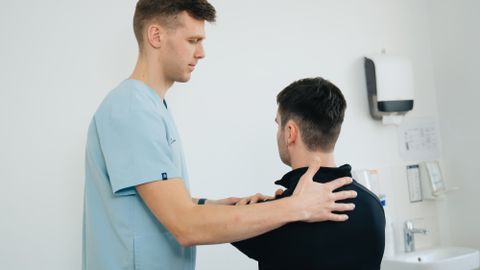
Hip pain in lifters most often shows up as a pinching sensation at the front of the hip or in the groin at the bottom of a squat, or as a deep ache after heavy hinging.
General information rather than diagnosis. Anything severe, traumatic, involving locking or giving way, or not settling needs assessment.
Hip anatomy is not standardised
The single most useful thing to understand. The angle of the femoral neck, the depth and orientation of the hip socket, and the shape of the femoral head all vary substantially between individuals.
Some people have deep sockets, some shallow. Some have sockets oriented more forward, some more to the side. These differences determine how much hip flexion and rotation is available before bone contacts bone, and they are structural — no amount of stretching changes them.
Which means the stance and depth that suits one person genuinely does not suit another, and the pinch some people feel at the bottom of a narrow-stance deep squat is bone against bone rather than a mobility deficit.
Femoroacetabular impingement
Extra bone formation on the femoral neck, on the socket rim, or both, reducing the clearance available in flexion and rotation. It is common — imaging finds these morphologies in a substantial proportion of people, many of whom have no symptoms at all.
The distinction that matters: having the bony shape is not the same as having the syndrome. Diagnosis requires symptoms, clinical signs and imaging findings together, not imaging alone.
Symptoms typically include groin pain with deep flexion, sometimes described as a pinch, and often a characteristic gesture — people cup the hip between thumb and forefinger to indicate where it hurts.
What usually helps
Change the stance. The most immediately effective intervention. Widening the stance and turning the toes out gives the femur a path into the socket that avoids the point of contact. Many people who cannot squat deep with a narrow stance can squat deep comfortably with a wider one.
Experiment systematically: try several stance widths and foot angles with a light load and find the one that allows depth without pinching.
Limit the depth. Squat to the depth that does not provoke symptoms, load it there, and stop treating full depth as compulsory. A well-loaded squat to just above the pinch point builds plenty of strength.
Elevate the heels. Reduces the ankle demand and changes the hip angle slightly, which sometimes helps.
Reduce the load temporarily and rebuild.
Strengthen the hip. Progressive loading of the glutes, hip abductors and external rotators has reasonable evidence in hip-related pain, and it is the mainstay of conservative management for impingement-related symptoms.
What tends not to help
Aggressive stretching into the painful range. If the limit is bony, stretching pushes bone into bone and irritates the joint and its surrounding tissue. Stretching into a pinch makes symptoms worse in a lot of people.
Foam rolling the hip flexors in the hope of releasing something. It does not change joint shape.
Continuing to force depth because someone said full depth is mandatory.
Other things that present as hip pain
Gluteal tendinopathy — pain on the outside of the hip over the bony prominence, often worse lying on that side. Responds to progressive loading of the hip abductors, and is aggravated by positions that compress the tendon, such as crossing the legs or sleeping with the top leg dropped forward.
Proximal hamstring tendinopathy — pain at the sitting bone, aggravated by hinging and by sitting on hard surfaces. Slow, and responsive to progressive hinge loading starting from a limited range.
Adductor-related pain — inner thigh and groin, common in people who do sport alongside lifting. Progressive adductor loading has good evidence.
Referred pain from the lumbar spine, which is worth considering when the hip examination does not fit.
When to get assessed
Clicking or catching with pain, particularly with a sensation of the joint locking. Pain that is severe or waking you at night. Significant loss of range. Symptoms not improving over six to eight weeks of modification. Any history of significant trauma.
Labral tears are common in the impingement population and, like many imaging findings, are also common in people without symptoms. Surgery has a place in selected cases and conservative management is the reasonable first line for most people.
The practical message: find the stance and depth your hips actually allow, load that hard, and stop trying to force a position your skeleton does not offer.