Technique
The squat depth argument, settled as far as it can be
Depth is treated as a moral question in most gyms. It is actually a question about what you are training for, what your hips are shaped like, and whether you can maintain position.
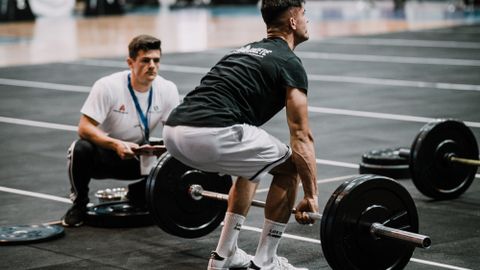
Few topics generate more confident nonsense than squat depth. Half the internet insists anything above parallel is a wasted rep; the other half claims deep squatting destroys knees. Neither position survives contact with the evidence or with anatomy.
What depth actually changes
As you descend, the moment arms at the hip and knee change, and so does which muscles do the work.
Deeper squatting increases the demand on the glutes and adductors substantially and increases the range over which the quadriceps work. It also increases the total mechanical work done per rep, since the bar travels further.
Partial squats allow much heavier loads, which places greater axial load on the spine and greater demand on the supporting musculature, and they train the top portion of the range specifically.
Neither is inherently correct. They are different exercises with different applications.
The knee objection is not supported
The claim that deep squatting damages knees has been examined repeatedly and does not hold up. Compressive forces at the knee do rise with depth, but so does the contact area distributing them, and shear forces — the ones people worry about for the cruciate ligaments — are generally lower in a deep squat than in a partial one at heavy load.
Populations who squat deeply under load routinely, including weightlifters, do not show the knee degeneration that the theory predicts. If anything the evidence points the other way, toward loaded full range of motion being protective for joint tissue.
What does cause problems is loading a depth you cannot control, with a position that collapses — knees caving hard, pelvis tucking under, spine rounding under load. That is a technique and load-management issue, not a depth issue.
The buttwink question
Posterior pelvic tilt at the bottom of a squat — the pelvis rotating under, the lower back rounding slightly — is extremely common and it is frequently over-diagnosed as a catastrophe.
A small amount at the very bottom of a bodyweight squat is normal and probably not a problem. A pronounced, early tuck under heavy load is worth addressing, because the lumbar spine is being loaded in flexion at the point of highest force.
Causes vary: genuine hip mobility restriction, ankle restriction forcing compensation, insufficient control at end range, or simply hip anatomy that does not allow that depth in that stance.
Hip anatomy is not the same in everyone
This is the part that gets left out of most depth arguments. The angle of the femoral neck, the depth and orientation of the hip socket, and the shape of the femoral head vary considerably between individuals, and these are structural.
Some people can squat deep with a narrow stance and toes forward. Others hit bony contact — the femur meeting the rim of the socket — well before that, and no amount of stretching changes it because it is bone against bone.
The practical consequence: stance width and foot angle are individual, and finding your own is a matter of experimentation rather than copying someone else's setup. Wider stance and more toe-out generally allows more depth for people with restrictive hip structure, because it moves the femur out of the position where it makes contact.
If a stance feels pinchy at the front of the hip at the bottom, that is a signal to change the stance, not to push harder into it.
So how deep should you go?
If you compete in powerlifting: at least to the depth the rules require, which is the hip crease below the top of the knee. Train slightly below it so competition depth is never in doubt.
If you compete in weightlifting: full depth, because the sport requires receiving the bar there.
If you train for general strength and muscle: the deepest range you can control with a stable spine and pelvis. For most people that is at or below parallel, and the deeper end has better evidence for muscular development.
If you have a specific reason to limit depth — a diagnosed condition, a rehabilitation protocol, a joint that genuinely does not tolerate it — then work in the range you have, load it well, and stop apologising for it.
Building depth if you want it
Ankle dorsiflexion is the most common limiter and the most responsive to work. Test it: kneel with the toes a hand's width from a wall and try to touch the knee to the wall without the heel lifting. If you cannot, that restriction is affecting your squat.
Load the range you want rather than only stretching it. Goblet squats held at depth, paused squats, tempo work, and squatting to a target that you lower over weeks all build tolerance and control in the bottom position better than passive stretching does.
And heeled shoes are a legitimate tool rather than cheating. Raising the heel reduces the ankle dorsiflexion required and lets many people reach depth with a more upright torso. Use them if they help.