Recovery
Rest between sets: longer than you think
Short rest periods feel productive and are, for most goals, counterproductive. The research here is clearer than the gym convention suggests.
Rest between sets is one of the few programming variables where the evidence pushed decisively against the conventional wisdom, and where the conventional wisdom has largely survived anyway.
The old model
The traditional recommendation was short rest — thirty to sixty seconds — for hypertrophy, on the theory that the metabolic stress and the hormonal response produced by shorter rests drove growth. Longer rests were reserved for strength work.
That model rested substantially on the acute hormone hypothesis, which has not held up, and on the assumption that metabolic stress was a primary growth driver, which appears to be less important than mechanical tension.
What the research found
Studies directly comparing rest intervals for hypertrophy have generally favoured longer rests. In several trials, participants resting around three minutes gained more muscle and more strength than those resting one minute, with everything else matched.
The mechanism is straightforward and does not require any exotic explanation: with longer rests, you complete more repetitions at a higher load across the session. More total volume at higher intensity produces more growth. Short rests reduce the work you can do.
For strength, longer rests have always been the recommendation, and that has not changed. Maximal force production requires substantial recovery of the phosphocreatine system and of neural readiness.
Practical guidance
Heavy compound lifts, low reps: three to five minutes. Sometimes longer for a maximal attempt.
Moderate compound work: two to three minutes.
Isolation work: ninety seconds to two minutes.
When time is genuinely constrained: use supersets of unrelated movements rather than cutting rest on the same movement. A set of rows, then a set of leg curls, then back to rows, gives each muscle several minutes of recovery while you are continuously working.
The one good use of short rests
Metabolic conditioning and work capacity. Deliberately short rests train the ability to recover quickly and produce a specific cardiovascular and metabolic demand.
That is a legitimate goal. It is a different goal from maximising strength or size, and confusing the two is where the problem arises.
Short rests also have a place at the end of a session on isolation work, where the fatigue cost is low and the time saving is real.
How to know if you rested long enough
The practical marker: could you complete the prescribed reps at the prescribed load with the intended proximity to failure?
If set three of five is dropping reps significantly compared with set one, either the load is too heavy, the target is too ambitious, or the rest is too short. On a strength-focused programme, the answer is usually the rest.
Breathing returning to something near normal and a subjective sense of readiness are reasonable indicators. Watching a clock is more reliable than feel, because feel drifts — people rest longer when tired and less when they are in a hurry, which is the opposite of useful.
The psychology of it
Long rests feel unproductive. Sitting on a bench for four minutes between sets feels like wasting time, and there is a strong pull toward filling the gap with something.
The reframe: the set is the training and the rest is what enables the next set to be worth doing. A session with six high-quality sets is better than one with twelve mediocre ones.
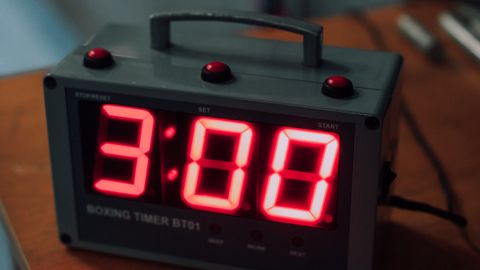
Practically, use a timer. Start it the moment the set ends. Without one, most people rest considerably less than they intend, and the variation between sets makes the training less consistent.
What to do during rest
Ideally not much. Sitting quietly, breathing, and preparing for the next set.
Avoid anything fatiguing for the same muscles. Light mobility work for an unrelated area is fine.
The phone is the main problem. Not because it is physiologically harmful, but because it destroys timekeeping — rest periods become four minutes or nine minutes depending on what you were reading.
The summary
Rest longer than feels comfortable, use a timer, and let the extra volume and load you can achieve be the evidence that it works.
If your sessions become too long as a result, reduce the number of exercises rather than the rest. Fewer, better sets is the trade you want.
Also by Hiro Tanabe
- What we still do not knowStrength Science
- Does muscle damage matter for growth?Strength Science
- Making weight without wrecking your performanceFuelling
- Who to trust: evaluating fitness information sourcesStrength Science


