Technique
Bracing, belts and the Valsalva manoeuvre
Trunk stiffness is what lets you transmit force from the ground to the bar. Most people brace by sucking in, which does close to the opposite of what is needed.
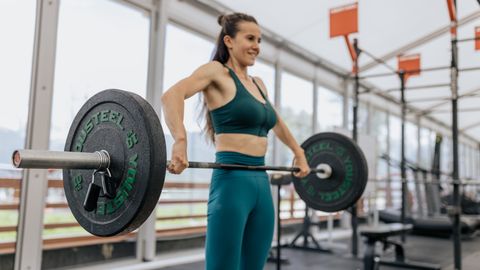
Under a heavy bar, the trunk's job is to be rigid. Force generated by the legs has to travel through the torso to reach the bar, and any softening in between is force lost — and, more importantly, load transferred to structures that should not be taking it.
How to brace
Take a breath into the belly rather than the chest. The diaphragm descends, intra-abdominal pressure rises, and the abdominal contents become a pressurised cylinder that supports the spine from the front.
Then contract the abdominal wall against that pressure — all the way around, including the obliques and the muscles at the back, not just the front. The sensation is expanding outward against a tight belt, not pulling in.
The common instruction to "suck in" or "pull the navel toward the spine" comes from a different context — rehabilitation research into deep muscle activation — and it is the wrong instruction under load. Hollowing reduces intra-abdominal pressure and reduces trunk stiffness. Bracing outward is what you want.
A useful test: have someone poke you in the side while you brace. If you can be poked easily, you are only bracing the front.
The Valsalva manoeuvre
Holding that pressurised breath through the effortful part of the lift is the Valsalva manoeuvre, and it is standard practice in heavy lifting for good reason — it produces the highest intra-abdominal pressure and the greatest trunk stiffness.
It also raises blood pressure sharply and transiently, which is the source of the caution around it.
For healthy people lifting heavy, brief Valsalva is generally considered acceptable and is essentially universal in strength sport. The blood pressure spike is short-lived and returns to normal quickly.
The caveats: it can cause light-headedness or fainting if held too long, which is why people sometimes see stars at the top of a heavy squat. Anyone with cardiovascular disease, uncontrolled hypertension, glaucoma or a history of retinal problems should discuss it with a doctor and generally avoid it.
The practical version: take the breath at the top, hold it through the hardest portion, and exhale near the end of the rep or at the top. Do not hold your breath through five consecutive reps of a heavy set — take a new breath at the top of each rep.
For lighter work, normal breathing is fine and there is no reason to Valsalva a set of curls.
What a belt does
A belt gives the abdominal wall something to brace against, which increases intra-abdominal pressure for a given effort. Studies have shown measurable increases in intra-abdominal pressure and, in some cases, in performance when wearing one.
What it does not do: replace bracing, support your back passively, or prevent injury by holding you together. A belt worn loosely or worn without bracing into it does essentially nothing.
The claim that belts weaken the trunk over time is not well supported. Studies have generally not found reduced trunk activation with belt use — if anything, muscle activity is similar or higher, because you are lifting more weight.
Using one properly
Position it over the abdomen, roughly around the navel, wherever it allows you to breathe into your belly and press outward. Not up under the ribs, not down on the hips.
Tighten it firmly but not maximally. You must be able to take a full breath into the belly against it. A belt so tight you cannot breathe defeats the mechanism.
Then breathe in, press out against the belt, and lift.
A stiff belt of consistent width all the way round is the standard for powerlifting. Tapered belts that are narrow at the front give you less to brace against at the point where it matters most.
When to wear it
Reasonable practice: for heavy sets on the main lifts, roughly above eighty percent of your maximum, and for maximal attempts.
Train without it for warm-ups, lighter work and most accessories, so that unbelted bracing remains competent.
A beginner should learn to brace properly without a belt first. The belt is an amplifier of a skill, and amplifying a skill you do not have produces nothing.
Building the underlying capacity
Trunk stiffness under load is trainable, and the exercises that build it are mostly anti-movement rather than movement.
Loaded carries — farmer's walks, suitcase carries, front-racked carries — are probably the most useful, because they demand sustained bracing under a real load while moving.
Planks and side planks, progressed by adding load or difficulty rather than by adding time. Anti-rotation work such as Pallof presses. Ab wheel rollouts, which are anti-extension under substantial load.
What is less useful for this purpose: high-repetition sit-ups and crunches, which train trunk flexion rather than the ability to resist movement, and which are not what the trunk does under a barbell.


