Strength Science
Range of motion and the case for training muscles long
One of the more interesting recent lines of research suggests that where in the range you load a muscle affects how much it grows.
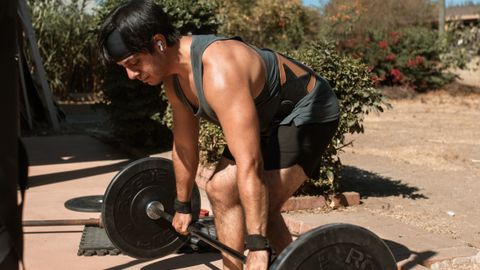
For years the standard advice was simply "full range of motion" — go all the way down, all the way up, and do not do partials. Recent research has refined that in an interesting direction.
The general finding
Comparisons of full versus partial range training have generally favoured full range for hypertrophy, particularly when the partial range is the shortened portion of the movement — the top half of a squat, the top half of a curl.
The proposed explanation is that muscles experience greater mechanical tension when working at longer lengths, and mechanical tension appears to be the primary driver of growth.
Lengthened partials
The more surprising finding is that partial repetitions performed in the lengthened portion of the range — the bottom half of a squat, the stretched portion of a curl or a lateral raise — have in several studies produced hypertrophy comparable to, and occasionally greater than, full range training.
This runs against the intuition that more range is always better, and it points at the same underlying idea: the lengthened position is where the growth stimulus is concentrated.
The research base is still developing. Several studies support it, the effect sizes vary, and the practical implications are not fully settled. It is a promising line rather than an established prescription.
What this suggests practically
Prioritise the stretched position. When choosing between exercises for the same muscle, favour those that load it at longer lengths.
Examples: incline dumbbell curls place the biceps in a lengthened position that a preacher curl does not. Overhead triceps extensions load the long head at length in a way pushdowns do not. Rear-foot elevated split squats load the quadriceps and hip flexors at length. Romanian deadlifts load the hamstrings at length; leg curls load them shortened. Deficit push-ups and deep dumbbell presses load the pectorals at length.
Do not cut the bottom of movements short. The portion people most often shorten — the deep part of a squat, the bottom of a press, the full stretch of a row — appears to be the most valuable part.
Consider lengthened partials as a tool for accessories, particularly at the end of a set when full range becomes impossible. Continuing with partial reps in the stretched range rather than stopping may add stimulus.
The caveats
It does not mean partials are better than full range in general. Full range remains a reasonable default and it has additional benefits: it maintains and improves flexibility, it trains strength across the whole range, and it is simpler to programme.
The lengthened position produces more muscle damage and soreness. Eccentric loading at long muscle lengths is the classic recipe for delayed onset soreness. A programme built entirely around lengthened work generates a lot of soreness, which has recovery costs.
It is more demanding on connective tissue. Loading a muscle at end range under heavy load is a legitimate injury risk if introduced abruptly. Progress into it.
Sport specificity still applies. A powerlifter needs strength at the range the competition requires, and a weightlifter needs strength in specific positions. Hypertrophy findings do not override specificity for a competitive lifter.
The related question of full range for strength
Strength adaptations are relatively specific to the range trained. Training partial range squats builds strength primarily in that range, with limited transfer to the full movement.
Which is a good argument for training full range as the default and using partials as a supplementary tool with a specific purpose — overloading a portion of the range, working around an injury, or accumulating stimulus at the end of a set.
Where the evidence sits
The broad conclusion — that training through a full range, with attention to the lengthened position, is at least as good as and often better than shortened or partial-range training — is reasonably well supported.
The stronger claim that lengthened partials are superior to full range is interesting, plausible and not settled. Treat it as a reason to include lengthened-biased work rather than as a reason to abandon full repetitions.
And note the size of the differences. These are refinements at the margin. A person doing full range work consistently with progressive overload is capturing nearly all the available benefit, and the remaining optimisation is smaller than the effect of an extra hour of sleep.
Also by Hiro Tanabe
- What we still do not knowStrength Science
- Does muscle damage matter for growth?Strength Science
- Making weight without wrecking your performanceFuelling
- Who to trust: evaluating fitness information sourcesStrength Science


