Programming
Volume: how many hard sets a muscle actually needs
The research on training volume is messier than the confident infographics suggest, but it does support a workable range and a clear principle about how to move within it.
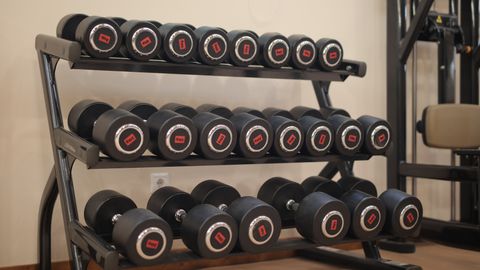
Volume is the variable most people either dramatically under-apply or dramatically over-apply, usually depending on which corner of the internet they learned from.
The honest position: the research supports a broad effective range, individual variation within that range is large, and more volume produces more growth up to a point that is different for everyone and for every muscle.
Counting it usefully
The most practical unit is hard sets per muscle group per week — sets taken reasonably close to failure, within roughly one to four repetitions of it. Warm-ups do not count. Sets stopped well short of a meaningful effort do not count for much either.
Tonnage — sets times reps times load — is a poor unit for hypertrophy because it treats a hundred easy reps as equivalent to a small number of hard ones, and they are not.
Count indirect work partially. Rows train biceps, pressing trains triceps, squats train the glutes. How much to count is a judgement, and the usual convention is to count indirect involvement as roughly half a set.
The rough numbers
Across the literature, something in the region of ten to twenty hard sets per muscle group per week captures most of what most trained people need for hypertrophy. Below about ten, results are generally sub-optimal for a trained lifter; above twenty, returns diminish and recovery cost climbs steeply.
Some studies have found continued benefit at higher volumes in some people, and some individuals genuinely thrive on more. Others get their best results in the lower part of the range and go backwards above it.
For pure strength, lower volumes with higher intensity are effective — strength is more responsive to specificity and heavy practice than to accumulated volume, though a base of muscle mass supports it.
Start low and add
This is the operative principle and it matters more than the specific numbers.
Begin at the lower end of the range — say ten sets per muscle group per week. Train there for several weeks and see how you progress and recover. If progress is good, stay. If progress has stalled and recovery is fine, add two or three sets per muscle group and reassess in a few weeks.
This approach finds your effective volume rather than assuming it, and it means you are always training at the lowest dose that works, which leaves room to add later.
The opposite approach — starting at maximum volume — leaves nowhere to go, accumulates fatigue quickly, and makes it impossible to distinguish a programme problem from a recovery problem.
Distribute across the week
Twenty sets for a muscle in one session is not equivalent to twenty sets across three sessions. The later sets in a long session are performed with substantial fatigue and lower quality, and there is evidence for diminishing returns within a session.
Splitting a muscle's weekly volume across two or three sessions generally produces better quality work per set and at least as good results. Frequency in the range of twice a week per muscle group is a sensible default.
Above roughly ten hard sets in a single session for one muscle group, you are probably past the point of usefulness for that session.
Volume is not free
Every set costs recovery, and recovery is finite and shared across the whole body. Adding volume to one muscle group reduces capacity elsewhere.
The signs of too much: performance declining across weeks, persistent joint discomfort, sleep disruption, sessions becoming unbearably long, and the general fatigue signals that indicate a deload is needed.
Also relevant: life stress, sleep and food all determine how much volume you can absorb. The same programme that works in a good month will bury you in a bad one, and adjusting volume down during difficult periods is intelligent programming rather than weakness.
Where volume matters less
For a beginner, almost any volume works and technique practice is the priority. Adding sets in the first six months is usually a mistake — the limiting factor is skill and connective tissue tolerance, not stimulus.
For maximal strength, quality of heavy practice dominates. A powerlifter's squat volume is driven by what they can recover from while still hitting heavy sessions.
Individualise, and accept that it takes time
The most useful thing to internalise is that the published averages describe populations, and you are one person with your own recovery capacity, training history, sleep, stress and genetics.
The number for you is found by starting conservatively, tracking honestly, adjusting gradually, and being willing to reduce as well as increase. That process takes months, which is why people prefer a number from an article — and why the number from the article works less well than the one you find yourself.