Recovery
Stretching and mobility: what each actually does
Flexibility and mobility are not the same thing, static and dynamic stretching do different jobs, and most of what is claimed for both is not supported.
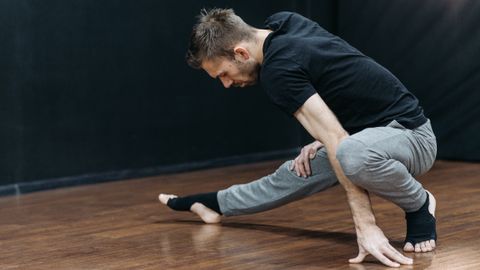
Stretching occupies a strange place: universally recommended, rarely done consistently, and credited with benefits it does not have while its actual uses go unmentioned.
Flexibility versus mobility
Flexibility is passive range of motion — how far a joint can be moved by an external force. Being able to have your leg pushed into a position.
Mobility is active range of motion — how far you can move a joint under your own control, with strength through that range. Being able to put your leg there yourself and hold it.
The gap between them matters. Someone can be very flexible passively and have no control at end range, which is not useful and may increase injury risk. Mobility — usable, controlled range — is what training actually requires.
This distinction explains why passive stretching often fails to improve movement: it addresses the wrong quality.
Static stretching
Holding a position at the end of range for a sustained period.
What it does: increases passive range of motion over weeks of consistent practice. The mechanism is debated — it appears to be substantially about increased tolerance to the stretch sensation rather than about lengthening tissue — but the range improvement is real.
What it does not do: prevent injury, as a general practice. Reduce soreness. Improve performance. The evidence for each of these is weak to absent.
The performance caveat: prolonged static stretching immediately before training can acutely reduce force production and power. The effect is modest and it is more pronounced with longer holds. Short stretches as part of a broader warm-up are unlikely to matter; ten minutes of deep static work before a heavy squat session is not a good idea.
When to use it: after training or in a separate session, when you actually want to increase range in a specific restricted area.
Dynamic stretching and movement preparation
Moving through a range repeatedly, progressively increasing amplitude.
This is what belongs in a warm-up. It raises tissue temperature, rehearses the movement patterns you are about to load, and increases range without the acute force reduction.
A sensible warm-up: a few minutes of general activity to raise temperature, then dynamic movement through the relevant ranges, then progressively loaded warm-up sets of the actual exercise. The warm-up sets are the most specific and most important part, and they are frequently rushed.
Loaded stretching and end-range strength
The approach with the best support for genuinely improving usable range is loading the muscle in a lengthened position.
Deep squats, Romanian deadlifts through a full range, deficit work, split squats with a long stride, controlled work at end range under load. These build both range and the strength to control it, which is what mobility means.
Full range of motion resistance training has been shown in several studies to improve flexibility comparably to stretching, while also building muscle — which makes it a considerably better use of the same time.
Foam rolling and soft tissue work
Produces a short-term increase in range of motion without the acute force reduction of static stretching, which makes it reasonable in a warm-up.
It does not break down adhesions, release fascia, or change tissue structure. The effects appear to be neurological and temporary — a modulation of the stretch tolerance rather than a physical change.
Modest evidence for reducing soreness perception. Pleasant, low-cost, low-risk. Fine to do; do not expect much.
When mobility work is genuinely warranted
When a specific restriction is limiting a specific movement you need. Ankle dorsiflexion limiting squat depth. Shoulder flexion limiting an overhead position. Hip internal rotation limiting a stance.
In those cases, targeted work on that restriction, combined with loading the position, produces results that matter.
General flexibility work in someone with no restrictions is a hobby, not training. There is no evidence that being more flexible than your activity requires is beneficial, and at the extremes there is reason to think excessive passive laxity without control is a problem.
How to actually improve a restriction
Test it first, so you know what you are working with and whether anything changed. Then combine three things: some passive stretching to increase tolerance, active work at end range to build control, and loaded work in the position over time.
Consistency matters more than duration. A few minutes most days beats a long session once a week.
And expect it to take weeks to months. Range of motion changes are slow, and the ones that persist are the ones you have built strength into.