Programming
Structuring a session: order, warm-ups and what to cut when time is short
The exercise order within a session has a real effect on outcomes, and the warm-up has less to do with stretching than most people think.
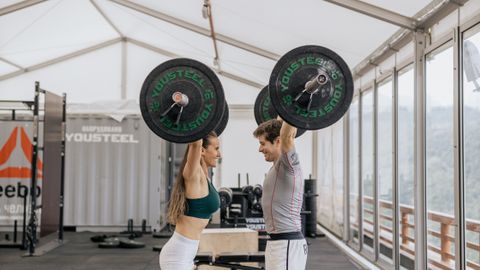
A training session is a sequence, and the sequence matters because fatigue accumulates. Whatever is first receives your best effort, and whatever is last receives whatever is left.
The warm-up, in its actual order of importance
1. General temperature rise. Five minutes of easy cycling, rowing or brisk walking. Raises muscle temperature, which improves force production, and gets blood flowing. Simple and genuinely useful.
2. Dynamic movement through the relevant ranges. Not stretching — moving. Bodyweight squats, hip circles, arm swings, band pull-aparts. A few minutes, targeted at what you are about to do.
3. Progressive warm-up sets in the actual lift. By far the most important part and the one most often rushed.
Start with the empty bar and build in steps to the working weight, reducing reps as the load rises. Something like the bar for eight, then progressively heavier sets of five, three, and a couple of singles near the working weight.
The purpose is threefold: rehearse the exact movement pattern with progressively more load, prepare the nervous system for the effort, and gather information about how you feel today, which should inform how the session goes.
Do not fatigue yourself. Warm-up sets stay well short of effortful — they are practice, not work.
What does not belong: prolonged static stretching, which acutely reduces force production. Save it for afterwards.
Exercise order
The principle is to put the highest-priority and most technically demanding work first.
Heaviest, most complex, most fatiguing lifts first. Squats, deadlifts, presses, Olympic variations. These require the most coordination and the most force, and they are the ones most degraded by fatigue.
Then secondary compounds. Rows, lunges, incline presses, hinges.
Then isolation work. Curls, extensions, lateral raises, calves. These have low technical demand and low injury risk when tired, which makes them the right thing to do last.
Then anything conditioning, if it is in the same session.
The main exception is deliberate pre-exhaustion or when a lagging area is the priority. If your rear delts are the weak point and they always get the tired end of the session, move them to the front on one day a week. Whatever comes first gets the best effort, so use that deliberately.
Session length
Most productive sessions are sixty to ninety minutes including the warm-up. Sessions running much beyond that usually contain a lot of low-quality work and a lot of standing around.
If a session is regularly over two hours, either the volume is too high for one session — split it — or the rest periods have become social.
Rest between sets, briefly
For heavy compound work, three to five minutes. Studies comparing rest periods have generally found longer rests produce better strength and, somewhat counterintuitively, better hypertrophy outcomes, because they permit more total volume at higher loads.
For isolation work, ninety seconds to two minutes is fine.
Short rests of under a minute are appropriate for specific metabolic work and they reduce the load and reps you can manage, which costs volume.
A practical approach for time efficiency: alternate between unrelated exercises — a set of rows, rest, a set of leg curls, rest — so each muscle gets full recovery while you are still working.
What to cut when time is short
This is the most useful section, because everyone has short days.
Keep: the main lift, warmed up properly. Even one main lift performed well is a productive session.
Cut first: isolation work. It contributes least per minute.
Cut second: the number of sets on secondary exercises, rather than removing them entirely.
Cut last: the warm-up. A rushed warm-up before a heavy lift is where things go wrong, and it is the first thing people skip.
Superset unrelated movements to compress time. Reduce rest on accessories but not on the main lift.
A twenty-five minute session containing a properly warmed-up main lift and two accessories is a genuinely useful training session. Skipping entirely because you do not have ninety minutes is the error.
The end of the session
No cool-down is strictly necessary. Light activity for a few minutes is pleasant and probably helps you feel better; it does not accelerate recovery meaningfully.
If you have specific mobility work to do, this is the place for it — the tissue is warm and there is no subsequent performance to protect.
And write down what you did before you leave. Sessions logged after the fact are logged inaccurately, and inaccurate logs are worse than none because you make decisions from them.