Technique
The deadlift setup: five things that decide the lift before it starts
A deadlift that fails usually failed in the setup. By the time the bar leaves the floor, most of the outcome has already been determined.
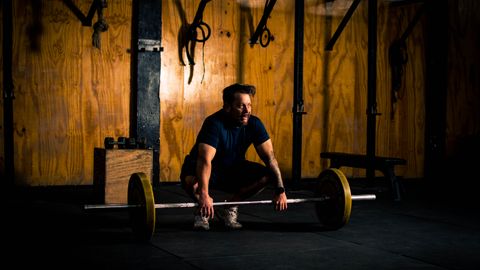
The deadlift looks like the simplest lift and has the most ways to be subtly wrong. Nearly all of them happen before the bar moves.
1. Bar position over the foot
The bar should sit roughly over the midfoot before you bend down — usually somewhere around a centimetre or two from the shin for most people, which places it over the balance point.
Too far forward and the bar has to travel backwards as it leaves the floor, which means a longer path and a worse lever. Too close and it drags the shins painfully and pulls you onto your toes.
Set this before you reach down, not after. Once you have gripped the bar you are far less able to judge it.
2. Stance and grip width
For a conventional pull, the feet sit roughly hip width with the toes turned out slightly, and the hands just outside the legs. The most common error is standing too wide, which shortens the effective leg length but interferes with the arms and usually makes the setup awkward.
Sumo is a different lift, not a variation: much wider stance, hands inside the legs, more upright torso, more demand on hips and quads and less on the lower back. Which one suits you depends on hip structure and leverages, and the honest way to find out is to train both for a few months and see.
3. Getting tight before you pull
This is the step most people skip and it is the most important.
After gripping the bar, pull the slack out — take the tension in the bar before the plates move, so you can feel the bar sitting against the collars. This is often described as "pulling the slack out of the bar" and there is an audible click when it happens with a good bar.
At the same time, engage the lats: think about pulling the bar back toward you, or about squeezing something under the armpits. Loose lats mean the bar drifts forward as it leaves the floor.
Then brace. A full breath into the belly, held, with the abdominal wall braced in all directions rather than just sucked in. The trunk is a pressure vessel and the pressure is what protects the spine and transmits force.
All of this happens in the two or three seconds before the pull, and it is why a rushed deadlift is a weak deadlift.
4. Hip height
The endless argument. The answer is that there is a correct hip height for your leverages, and it is the one where the bar leaves the floor without your hips shooting up first.
Hips too low and you are trying to squat the weight up; the hips rise before the bar does, wasting the leg drive and putting you into a worse position.
Hips too high and it becomes a stiff-legged pull with enormous demand on the lower back.
The practical method: set up so that your shoulders are slightly in front of the bar, your shins are close to vertical or slightly angled, and your back is set flat. Then film a set from the side. If the hips rise before the bar, start higher. If your back rounds immediately, you may be too high or you may need more bracing.
5. Spine position, honestly
Aim for a neutral, braced spine. A hard arch is unnecessary and puts the lumbar spine under extension load at the same time as compression; a heavily rounded lower back under maximal load is where people get hurt.
A small amount of upper back rounding under heavy loads is common in elite lifters and is a different matter from lumbar flexion. The distinction is worth understanding: the thoracic spine tolerates flexion far better than the lumbar spine does.
What matters most is that the position does not change during the lift. A back that starts flat and rounds progressively under load is a signal that the weight is too heavy for the current bracing capacity.
Then the pull itself
Push the floor away rather than yanking the bar up. The mental cue matters because it changes how the leg drive is sequenced.
Keep the bar against the body the whole way. Any gap between the bar and the legs is a longer moment arm and a harder lift.
Finish by standing tall with the hips through, not by leaning back. Hyperextending at the top adds nothing and loads the lumbar spine unnecessarily.
The reset between reps
For heavy work, reset fully every rep: put the bar down, re-establish position, re-brace, pull. Touch-and-go reps are a legitimate variation but they let position degrade across a set, and the last rep of a bouncy set is usually the worst-looking one you have done.
Film your setup occasionally. Nearly everyone's is worse than they think, and it is the cheapest technical improvement available.


